

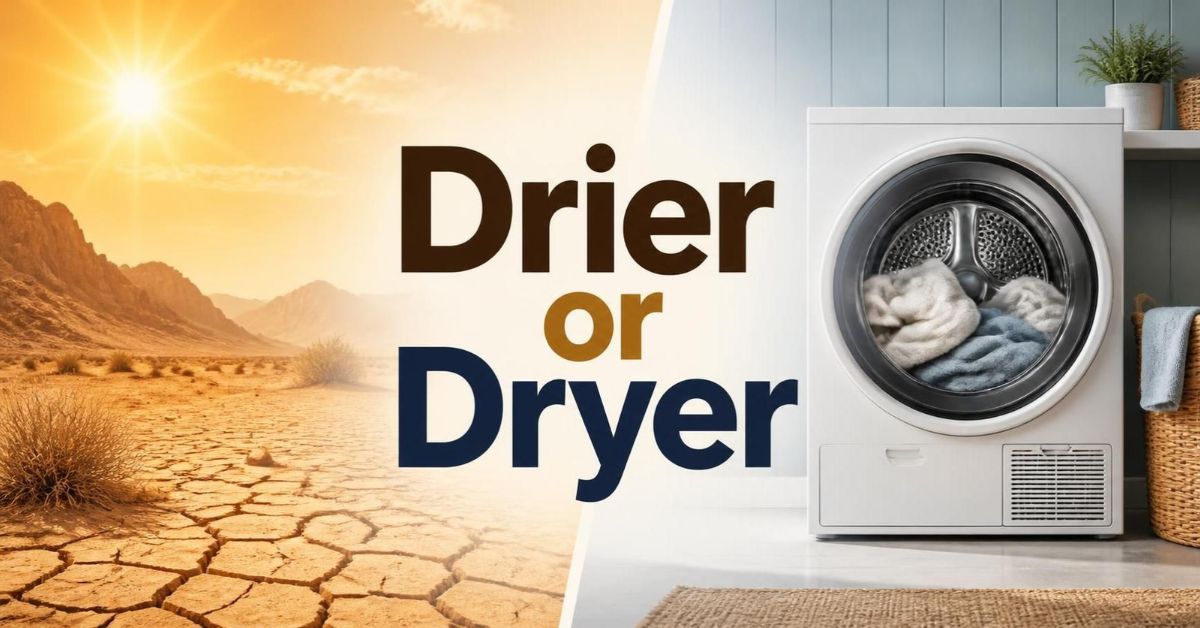
Drier and dryer are both correct English words, but they have different uses.
Drier usually means something has less moisture, while dryer commonly refers to a machine that removes moisture, such as a clothes dryer or hair dryer.
The confusion comes from the word dry and the way English forms new words.
If you are writing about dry weather, skin, or wine, drier is often the right choice.
If you mean a household appliance, dryer is usually correct.
However, dryer can also appear as a comparative adjective, so context matters.
This guide explains the drier or dryer difference with simple definitions, everyday examples, spelling rules, and practical tips.
By the end, you’ll know which spelling fits your sentence and how to avoid common mistakes.
Quick Answer
Drier is the comparative form of the adjective dry.
Use it when comparing the level of dryness between two things.
For example, the air feels drier today than it did yesterday.
It can describe skin, weather, soil, wine, and other things with less moisture.
Dryer is most commonly a noun meaning a device that removes moisture.
A clothes dryer dries laundry, while a hair dryer helps dry your hair.
The word can also function as a comparative adjective, as in a dryer climate.
The correct choice depends on whether you mean a greater degree of dryness or a drying device.
Why People Confuse Them
The drier vs dryer spelling difference looks small, and both words come from dry.
They also sound alike in many English accents, which makes the correct word harder to identify when speaking.
When writing, readers must rely on context to understand which meaning you intend.
English spelling rules add to the confusion.
Many adjectives ending in a consonant plus y change the y to i before taking an ending, as in dry to drier.
However, dryer also follows a familiar pattern for forming a noun that describes a thing that performs an action.
That is why both spellings are valid, even though they serve different purposes.
Key Differences At A Glance
| Feature | Drier | Dryer |
| Main use | Comparative adjective | Noun, usually |
| Meaning | Less wet or more dry | A device that removes moisture |
| Base word | Dry | Dry |
| Example | The soil is drier now. | The clothes are in the dryer. |
| Common contexts | Weather, skin, soil, wine | Laundry, hair care, hand drying |
| Can describe dryness? | Yes | Yes, in comparative use |
The easiest way to remember the drier vs dryer difference is to look at the word’s job in the sentence.
If you are comparing moisture levels, drier is usually the natural choice.
If you are naming a machine, dryer is the standard spelling.
For example, you might say that your towels feel drier after spending another hour outside.
You would say that you put those towels in the dryer when referring to the appliance.
The surrounding words usually make the intended meaning clear.
Meaning and Usage Difference
Drier Meaning
Drier means less wet or having less moisture than something else.
It is the comparative form of dry, and it often appears with than when comparing two conditions.
For example, this room is drier than the kitchen.
The sentence compares the level of moisture in two places.
You can use drier for weather, skin, soil, air, and even certain types of humor.
For example, the garden becomes drier during a hot spell, or your skin may feel drier in winter.
In each case, the word describes a change or difference in dryness rather than a machine.
Dryer Meaning
Dryer most often refers to a device that removes moisture from something.
A clothes dryer dries laundry, a hair dryer blows warm or cool air to dry hair, and a hand dryer dries wet hands.
These are all examples of a drying appliance or drying device.
The word dryer can also act as a comparative adjective.
For example, this towel is dryer than the other one is grammatically possible, although many writers prefer drier for a simple comparison.
In everyday English, drier is generally the more familiar comparative spelling, while dryer is strongly associated with appliances.
Tone, Context, and Formality
The choice between drier and dryer does not usually change the tone of your writing.
It changes the meaning, so choosing the right spelling helps readers understand your point without stopping to guess.
In everyday conversation, drier sounds natural when you describe weather or compare two things.
For example, you might tell a friend that the air feels drier today.
In a product review, however, dryer is the expected word when discussing a drying appliance, its settings, or its performance.
Formal writing follows the same distinction.
In an article about climate, use drier to describe conditions with less moisture.
In an instruction manual, use dryer when referring to a machine, its controls, or its dryer cycle.
Neither word is inherently more formal than the other.
Which One Should You Use?
Ask yourself one simple question: am I describing dryness or naming a device?
If you are describing something that has less moisture, choose drier.
If you are naming a machine that removes moisture, choose dryer.
Consider these everyday examples:
- The bedroom feels drier after running the dehumidifier.
- Put the wet clothes in the dryer.
- My hands get drier when the weather turns cold.
- Clean the dryer vent regularly to help maintain airflow.
- This wine tastes drier than the sweeter variety.
- I bought a new hair dryer for my morning routine.
These examples show how context guides correct word choice.
If you replace one spelling with the other, the sentence may become confusing or suggest a different meaning.
When One Choice Sounds Wrong
Some sentences sound wrong because the spelling does not match the intended meaning.
For example, saying that you put your clothes in the drier may confuse readers who expect the standard appliance name, dryer.
Although a reader might understand your meaning, dryer spelling is the usual choice for laundry equipment.
The opposite mistake happens when someone writes that the weather is dryer than yesterday.
This form is possible because dryer can function as a comparative adjective, but drier is the conventional and generally preferred choice in this context.
For clear, natural writing, use drier when describing weather, skin, soil, or similar conditions.
Common Mistakes (and Quick Fixes)
A common mistake is assuming that drier is always an adjective and dryer is always a noun.
That shortcut works in many everyday situations, but it is not a complete grammar rule.
Drier is the usual comparative adjective, while dryer can also be a comparative adjective in certain contexts.
Another mistake is applying the y to i spelling rule without considering the word’s function.
The base word dry becomes drier when you compare degrees of dryness.
The noun dryer uses the noun-forming ending -er to identify a device that dries something.
Here are quick fixes for common spelling mistakes:
- Incorrect for the usual appliance name: Put the towels in the drier.
Better: Put the towels in the dryer. - Preferred for a weather comparison: The climate is dryer this year.
Better: The climate is drier this year. - Correct: My skin feels drier after washing it.
- Correct: The hair dryer stopped working.
- Correct: This fabric dries faster in the tumble dryer.
Remember that the aim is not to force one spelling into every sentence.
It is to match the spelling to the meaning and follow common English usage.
Everyday Examples
Real-life examples make the drier or dryer usage easier to remember.
Think about what you might say at home, at work, or while talking about the weather.
Weather and climate: The air feels drier after the rain stops.
The region has a drier climate than the coastal area.
Skin and personal care: My skin gets drier during the colder months.
A hair dryer helps me style my hair before leaving home.
Laundry and household appliances: The towels feel drier after another spin in the machine.
The dryer has a timer that lets you choose the length of the cycle.
Food and drink: This wine tastes drier than the previous one.
The recipe works better with drier bread because it absorbs more liquid.
Writing and humor: His humor became drier as the conversation continued.
The joke uses a drier style than the comedy show we watched yesterday.
Notice how each example points toward a particular meaning.
If you are comparing a degree of dryness, drier is generally the safest choice.
If you mean a thing that dries, dryer is the standard noun.
Drier or Dryer in American English
In standard US English, drier is the usual comparative form of dry, and dryer is the familiar spelling for a machine.
You will see dryer on appliance labels, product packaging, instruction manuals, and laundry-room signs.
Meanwhile, weather reports and everyday descriptions commonly use drier to compare moisture levels.
This distinction is not simply an American-versus-British spelling difference.
Both spellings are used in English, and the main distinction concerns meaning and grammatical function.
When in doubt, follow the wording used by a reputable dictionary and the established usage in your sentence.
How to Remember Drier vs Dryer
Try this simple memory trick: drier describes; dryer dries.
If you are describing something with less moisture, think of drier.
If you are talking about a machine that dries clothes, hair, or hands, think of dryer.
You can also remember the spelling through familiar phrases.
A drier climate describes the weather, while a clothes dryer names an appliance.
These short associations help you make the right choice without memorizing a long list of rules.
| You May Also Like: |
| Weiner or Wiener: Which Spelling Is Correct in 2026? |
| Totalling or Totaling: Which Spelling Is Correct in 2026? |
| Diddo or Ditto: Common Mistake or Correct Spelling? 2026 |
Dictionary-Style Word Details
Verb
The base verb is dry, which means to remove moisture or to become free of moisture.
For example, you can dry a wet shirt with a towel, or the shirt can dry in the sun.
The verb itself does not change to drier or dryer simply because you are describing the action.
Common forms include dry, dries, dried, and drying.
For instance, the sun dries the clothes, the clothes dried overnight, and the clothes are drying outside.
Understanding these forms helps separate the verb from the comparative adjective and the noun.
Noun
Dryer is a countable noun when it refers to a device that removes moisture.
Examples include a clothes dryer, a hair dryer, and a hand dryer.
You can say that a dryer needs cleaning or that the dryer is running.
The word drier can also appear as a noun in some contexts, particularly in technical or regional usage, but it is far less common as the everyday name for a household appliance.
For ordinary writing, use dryer when referring to laundry equipment or another drying machine.
This choice matches common dictionary usage and what most readers expect.
Synonyms
The best synonym depends on the meaning you want to express.
For drier, useful alternatives include less moist, less damp, more arid, and less humid, although these terms are not interchangeable in every situation.
For dryer as a device, possible alternatives include drying machine, clothes-drying machine, and tumble dryer.
A hair dryer may also be called a blow dryer, especially in American English.
Choose a synonym that fits the object and the context rather than swapping words without checking their meaning.
Example Sentences
Here are additional drier and dryer examples that show how each word works in a sentence.
Pay attention to whether the word describes a comparison or names a device.
- The towels are drier after hanging outside all afternoon.
- We need a dryer with enough capacity for our family.
- The air becomes drier when the heating system runs.
- She used a hair dryer to finish styling her hair.
- This part of the garden is drier than the shaded area.
- The hand dryer stopped working in the public restroom.
- My lips feel drier in cold weather.
- The new washer and dryer fit neatly into the utility room.
These sentences cover common household, personal-care, and environmental contexts.
Reading them aloud can help you recognize which spelling fits the meaning you want.
Word History
Both words developed from the English word dry, which has a long history in the language.
The comparative form drier follows a familiar English pattern in which an adjective ending in y changes to i before the comparative ending.
The noun dryer follows the common -er pattern used for people or things that perform an action.
Similar examples include a heater that heats and a printer that prints.
This pattern explains why dryer became the familiar name for a machine that dries clothes or other materials.
Phrases Containing
Common phrases can make the spelling easier to recognize in context.
The following expressions show how the words appear in everyday English.
- Drier air: air containing less moisture than another air mass.
- Drier climate: a climate with less moisture or precipitation in the relevant comparison.
- Drier skin: skin that has less moisture than before.
- Drier wine: wine with less perceived sweetness.
- Clothes dryer: a machine used to dry laundry.
- Hair dryer: a device that directs air onto wet hair.
- Hand dryer: a device designed to dry wet hands.
- Dryer sheet: a sheet used in some clothes dryers to reduce static or add fragrance.
- Dryer vent: a passage that carries exhaust air away from a clothes dryer.
- Dryer cycle: a selected operating period or program for drying laundry.
These phrases illustrate the difference between describing a condition and naming an appliance.
Learning them as complete expressions can make spelling decisions quicker.
Frequently Asked Questions
Is drier a correct word?
Yes, drier is correct English.
It usually means something has less moisture than something else.
Is dryer a noun or adjective?
Dryer is usually a noun for a drying machine.
It can also work as a comparative adjective in some sentences.
Is it drier or dryer for clothes?
Use dryer when you mean the machine that dries clothes.
Use drier when comparing how dry the clothes have become.
Is hair drier or hair dryer correct?
Hair dryer is the standard spelling for the appliance.
It refers to the device used to dry and style hair.
Why are drier and dryer spelled differently?
Drier follows the comparative spelling pattern for dry.
Dryer commonly uses the noun-forming ending -er to name a drying device.
What is the difference between drier vs dryer in American English?
In American English, drier usually describes less moisture, while dryer usually names an appliance.
Both words are correct, depending on context.
Can I say the weather is dryer?
Yes, readers will understand the comparison.
However, drier is the more conventional choice when describing weather conditions.
How can I remember drier or dryer?
Remember that drier usually describes dryness, while a dryer dries things.
This simple distinction works for most everyday writing.
Conclusion
The difference between drier or dryer comes down to meaning and context.
Drier is usually the comparative form of dry, while dryer commonly refers to a machine that removes moisture.
For example, you might describe the air as drier today or put your wet clothes in the dryer.
When choosing between drier vs dryer, think about what your sentence describes.
Use drier for comparisons involving weather, skin, soil, or wine.
Choose dryer when referring to a clothes dryer, hair dryer, or hand dryer.
Although dryer can also serve as a comparative adjective, drier is generally the more natural choice for describing less moisture.
Keep this simple rule in mind, and you’ll make the right spelling choice in most everyday situations.
