

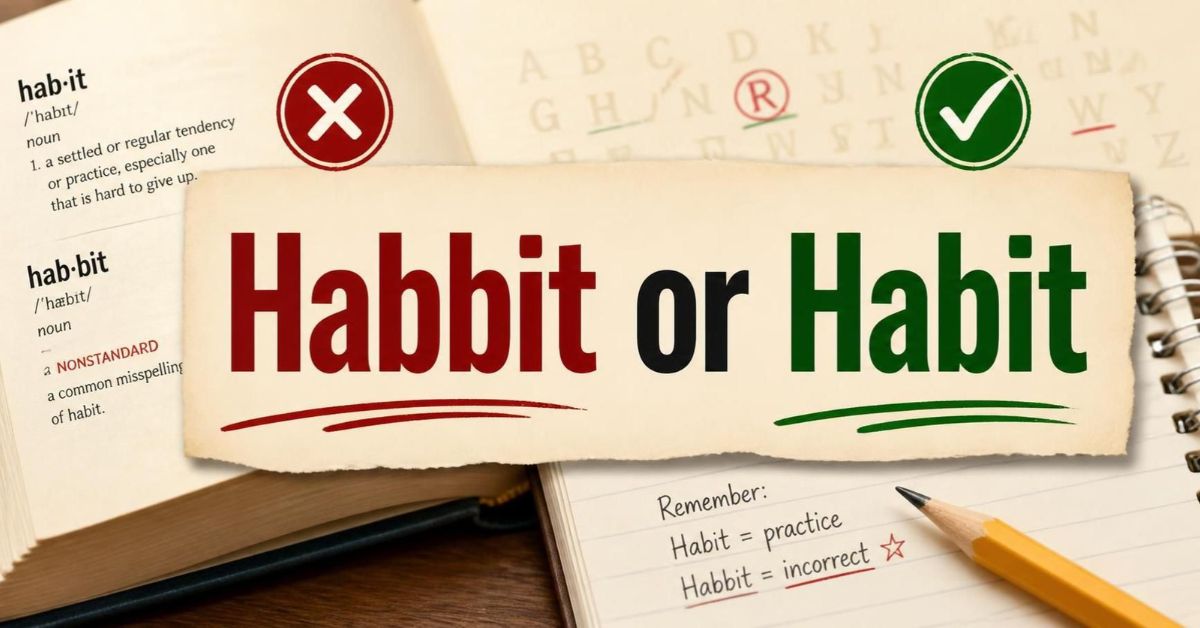
Have you ever typed habbit or habit and wondered which spelling is right? You’re not alone. Many English learners and native speakers accidentally add an extra letter when writing familiar words. The correct spelling is habit, with just one b. Habbit is a common spelling mistake, not a standard English word.
A habit is something you do regularly, often without thinking much about it. Brushing your teeth, checking your phone, and reading before bed are everyday examples. The word has the same spelling in American English and British English. There’s no regional variation to remember. If you’re writing an email, school assignment, blog post, or social media caption, always use habit. This guide explains its meaning, spelling, plural form, synonyms, and everyday usage. You’ll also learn a simple memory trick to avoid this mistake.
Quick Answer
Habit is the correct spelling in standard English. It has one b, and its plural form is habits. The spelling habbit, with two Bs, is incorrect in ordinary English writing.
For example, you might write, I have a habit of drinking water after waking up. Writing I have a habbit of drinking water is a spelling error. Remember this distinction whenever you use the word in casual messages or professional writing.
Why Do People Confuse Habbit and Habit?
The confusion often comes from how people remember words rather than how those words are officially spelled. When you type quickly, your fingers may repeat a letter accidentally. This creates the habbit spelling mistake, especially when you write without checking your text.
Another reason is that English contains words with doubled consonants, such as rabbit and hobby. Because these familiar words have two Bs, writers sometimes apply the same pattern to habit. However, English spelling doesn’t follow one simple rule for every word. The best approach is to remember the correct spelling of each word you use frequently.
Habit vs. Habbit at a Glance

The difference between habit and habbit is straightforward. One is the standard spelling, while the other is a misspelling. Both may look familiar to readers, but only habit belongs in standard written English.
| Feature | Habit | Habbit |
| Spelling | Correct | Incorrect |
| Number of Bs | One | Two |
| Part of speech | Noun | Not a standard English word |
| Plural form | Habits | Habbits is incorrect |
| American English | Correct | Incorrect |
| British English | Correct | Incorrect |
| Formal writing | Appropriate | Avoid |
| Everyday writing | Appropriate | Avoid |
If you’re comparing habit vs habbit, choose habit every time. You don’t need a different spelling for schoolwork, business emails, academic writing, or everyday conversations.
Meaning and Usage of Habit
The habit meaning refers to an action or behavior that someone repeats regularly. Over time, that action may become familiar or automatic. For example, you might lock the door before leaving home without consciously reminding yourself each day.
The habit definition also includes a person’s usual tendency or pattern of behavior. A person may have a habit of arriving early, interrupting others, or saving a small amount of money each week. Habits can be helpful, harmful, or neutral, depending on what you do and how it affects your life.
Here are a few examples of habit usage in English:
- Reading for ten minutes before bed is a good habit.
- Checking your phone during conversations can become a bad habit.
- Drinking water after waking up is a healthy habit.
- Arriving early is a useful habit at work.
- Biting your nails may be an unwanted habit.
Notice that the word describes a repeated action or tendency. It doesn’t automatically mean something negative. A habit can support your goals or create problems, depending on the behavior.
Tone, Context, and Formality
The word habit works naturally in casual and formal situations. You can use it when talking with friends, writing a workplace email, completing an assignment, or explaining behavior in an article. Its meaning stays the same across these contexts.
The spelling doesn’t change with tone or formality. Writing habbit in a casual text doesn’t make it an accepted alternative. Friends may understand what you mean, but standard spelling still matters when you want your message to look clear and polished.
For example, write, I’ve developed a habit of reviewing my notes every evening. In a professional email, you could say, I make it a habit to check each report before sending it. Both sentences use the correct spelling.
Which One Should You Use?
Use habit whenever you mean a repeated action, usual behavior, or personal tendency. This is the correct spelling in standard US English and British English. You don’t need to consider the audience’s country before choosing it.
If you see habbit while proofreading, correct it to habit. The same applies to related forms such as habits and habitual. Checking these words before publishing can prevent avoidable spelling errors in blog posts, assignments, reports, and emails.
A quick proofreading check can help:
- Search your document for habbit.
- Replace incorrect instances with habit.
- Check whether the plural should be habits.
- Read the sentence again to confirm its meaning.
These small steps make your writing more reliable without requiring complicated grammar rules.
When Does Habbit Look Wrong?
Habbit looks wrong whenever you use it as the ordinary English word for a repeated behavior. It isn’t a recognized alternative spelling in standard American or British English. If you encounter it in an article or message, it’s usually a typo.
You might occasionally see Habbit used as a brand name, username, product name, or deliberately invented term. In those cases, the unusual spelling may be intentional. That doesn’t make it the correct spelling of the common noun habit.
Context matters when you’re checking a word. A business may choose a creative name, but a student writing about study habits should use the standard spelling. Unless you’re reproducing a specific name, choose habit.
Common Mistakes and Quick Fixes
Spelling mistakes often happen because a word looks familiar enough to type without thinking. Learning the most common errors helps you catch them before they reach your readers. The following examples cover mistakes related to the correct spelling of habit.
1. Writing Habbit With Two Bs
The first mistake is adding an extra B. Habit contains one B followed by I and T. Writing habbit adds a letter that doesn’t belong.
Incorrect: Exercise is a healthy habbit.
Correct: Exercise is a healthy habit.
When proofreading, pay attention to the middle of the word. You don’t need to change the pronunciation or meaning. Simply remove the extra B.
2. Using Habbits as the Plural
The plural of habit is habits, not habbits. English forms the plural by adding S to the singular noun. It doesn’t require another B.
Incorrect: Good habbits can improve your day.
Correct: Good habits can improve your day.
If you’re unsure about habits or habbits, remember that the singular form is habit. Adding S gives you habits. The spelling remains consistent.
| You May Also Like: |
| Matt or Mat: Which Spelling Is Correct in 2026? |
| Afterward or Afterwards: Which Spelling Is Correct in 2026 |
| Humour or Humor: Which Spelling Is Correct in 2026? |
3. Treating Habbit as a Casual Spelling
Some people assume that habbit is acceptable in informal messages because readers can understand it. However, casual writing doesn’t change standard spelling rules. A text message can be relaxed without using an incorrect word.
Incorrect: My worst habbit is staying up late.
Correct: My worst habit is staying up late.
You don’t need formal language to write correctly. Use the right spelling even when chatting with friends or posting online.
4. Thinking Habit Only Refers to Bad Behavior
Another common misunderstanding involves meaning rather than spelling. Some writers use habit only when describing unwanted behavior, such as smoking or procrastinating. However, a habit can be positive or neutral.
For example, exercising every morning is a healthy habit. Drinking coffee after lunch may be a neutral habit. Interrupting people repeatedly can be an unwanted habit. The word describes the pattern, not whether it’s good or bad.
Everyday Examples of Habit
Examples make the meaning of a word easier to remember. A daily habit can involve your health, work, relationships, or free time. Once you recognize habits in ordinary situations, you’ll find it easier to use the word naturally.
Here are some habit examples in sentences:
- My reading habit helps me learn new words.
- She has a habit of arriving early for meetings.
- His sleep habit changed after he started working nights.
- Saving money every payday is a useful habit.
- Checking notifications during dinner has become a bad habit.
- We developed a habit of walking after breakfast.
- Good study habits can make exam preparation easier.
- He has a habit of writing tomorrow’s tasks before bed.
Each example describes a repeated action or familiar tendency. You can replace the subject or activity to create your own sentences. For instance, I have a habit of preparing my clothes the night before work.
Habit and Routine: What’s the Difference?
A habit and a routine are related, but they aren’t exactly the same. A habit is a behavior you repeat regularly, sometimes automatically. A routine is a sequence of activities you follow as part of a schedule or plan.
For example, brushing your teeth before bed may be a habit. Your entire evening routine might include preparing dinner, cleaning the kitchen, brushing your teeth, and reading for a few minutes. The routine contains several activities, while individual habits can form part of it.
The habit and routine difference becomes clearer when you consider intention. You might plan a morning routine deliberately, but some actions within it can eventually become automatic. The two concepts overlap, yet they describe different aspects of everyday behavior.
Dictionary-Style Word Details
Understanding a word’s grammatical role helps you use it correctly in different sentences. Habit primarily functions as a noun. Its related forms include habitual, an adjective, and habitually, an adverb.
The spelling remains habit when you’re using the noun. The word’s grammatical role and the surrounding sentence determine how you use it, not whether you add a second B.
Habit as a Noun
As a noun, habit refers to a repeated action, a tendency, or a usual way of behaving. It can describe something you do regularly or a pattern associated with a person.
Examples include, Reading is a daily habit, and She has a habit of checking the weather before leaving home. In both sentences, habit names a behavior or tendency.
Habbit as a Noun
Habbit isn’t the standard spelling of the English noun. You shouldn’t use it when describing a repeated action, personal routine, or behavior pattern.
For example, write, His habit of arriving early impressed the manager. Don’t write, His habbit of arriving early impressed the manager. The first sentence follows standard English spelling.
Habit as a Verb
In standard contemporary English, habit is primarily a noun, not a regular verb. You wouldn’t normally say, I habit myself to exercise every morning.
Instead, use expressions such as develop a habit, form a habit, or get into the habit of exercising. You can also use habitual as an adjective, as in habitual behavior, or habitually as an adverb, as in She habitually arrives early.
Synonyms for Habit
The best synonyms for habit depend on what you want to express. Some words describe repeated actions, while others refer to customs, tendencies, or established ways of doing things. They’re related, but they aren’t interchangeable in every sentence.
| Synonym | Meaning | Example |
| Routine | A regular sequence of activities | My morning routine starts with breakfast. |
| Pattern | A repeated way something happens | He noticed a pattern in his spending. |
| Custom | A traditional or usual practice | Sharing meals is a family custom. |
| Practice | A repeated activity or established method | Daily writing is a useful practice. |
| Tendency | An inclination to behave a certain way | She has a tendency to arrive early. |
| Behavior | The way someone acts | His behavior changed over time. |
| Tradition | A practice continued over time | Reading together is a family tradition. |
Use routine when you mean a planned sequence of activities. Choose tendency when describing how someone usually behaves. Custom and tradition work better for practices shared by families or communities.
Common Phrases With Habit
English contains several familiar expressions that use the word habit. Learning these phrases helps you understand everyday conversations and write more naturally. Each expression emphasizes a slightly different part of repeated behavior.
Break a habit
To break a habit means to stop doing something you regularly do. For example, I’m trying to break the habit of checking my phone during meals.
Build a habit
To build a habit means to develop a behavior through regular repetition. You might build a reading habit by reading five pages every evening.
Make it a habit
To make it a habit means to turn an action into something you do regularly. For example, make it a habit to review your spending every Sunday.
Out of habit
Doing something out of habit means doing it automatically because you’re used to it. She opened the fridge out of habit, even though she wasn’t hungry.
Force of habit
The phrase force of habit describes an action that happens because it has become familiar. I reached for my phone out of force of habit while waiting for the bus.
Creature of habit
A creature of habit is someone who prefers familiar activities or established patterns. He’s a creature of habit and orders the same lunch every Friday.
Old habits die hard
The expression old habits die hard means that familiar behaviors can be difficult to change. Even after buying an alarm clock, she kept checking her phone before bed because old habits die hard.
Habit or Habbit: Easy Memory Trick
Here’s a simple habit memory trick: remember that habit has one B, just like the phrase one B, one habit. When you write the word, picture the letters H-A-B-I-T in your mind. Repeating the correct spelling can make it easier to recall later.
You can also connect the spelling with a sentence you use regularly. For example, I have a habit of spelling habit correctly. It may sound a little repetitive, but that repetition helps reinforce the correct letter pattern.
If you still make the same mistake, add habit to your phone’s personal dictionary or use spell-check while writing. A quick correction today can prevent the same error from appearing in future emails, assignments, or articles.
How to Check Habit in Your Writing
A quick spelling check is useful when you’re editing longer documents. Search for the exact spelling habbit, then review each result. This catches the error even when spell-check misses it or you’re proofreading a large article.
Next, check the plural form and sentence meaning. If you’re referring to more than one behavior, use habits. If you’re describing a single repeated action, use habit. These simple checks cover most everyday uses.
Remember that spelling tools can help, but they don’t replace careful reading. A word may look correct to an automated tool in a different context, especially when it appears inside a brand name or unusual phrase. Read the complete sentence before making a change.
Frequently Asked Questions
Is habit or habbit correct?
Habit is correct in standard English. Habbit is a misspelling, so use habit in everyday messages, schoolwork, and professional writing.
Is habbit a word?
Habbit isn’t a standard English word for repeated behavior. It may appear as a creative name, but the correct common noun is habit.
Does habit have one b or two?
Habit has one B. The correct spelling is H-A-B-I-T, without a repeated consonant.
What is the plural of habit?
The plural of habit is habits. Add S to the singular form without changing its spelling.
Is habbit a British spelling?
No, habbit isn’t a British spelling. Both British English and American English use habit with one B.
Can habit be a good thing?
Yes, a habit can be positive, negative, or neutral. Regular exercise and reading are useful habits, while constant procrastination may be harmful.
What is an example of habit?
Brushing your teeth before bed is a common habit. It describes an action you repeat regularly as part of your daily life.
What is the difference between habit and routine?
A habit is a repeated behavior that may become automatic. A routine is a sequence of activities you follow regularly.
How do you remember the spelling of habit?
Remember that habit has one B. Picture H-A-B-I-T whenever you write the word to avoid adding an extra letter.
Is habbits correct?
No, habbits is incorrect in standard English. The correct plural is habits, with one B followed by S.
Conclusion
When comparing habbit or habit, the answer is simple: habit is the correct spelling. It uses one B in both American English and British English. Habbit is a common spelling mistake, not an accepted alternative for the ordinary English noun.
A habit describes a repeated action, usual tendency, or familiar behavior. It can be something positive, such as reading daily, or something you want to change, such as checking your phone too often. The plural is habits, and related expressions include build a habit, break a habit, and out of habit. Remember the five letters in H-A-B-I-T whenever you’re unsure. With this simple spelling check, you can avoid the same error in emails, articles, assignments, and everyday conversations. If you have another commonly confused spelling, share it and keep improving your English one word at a time.
