

Ever sat at a family reunion and wondered how you’re related to the guy by the grill? You’re not alone. Cousin labels trip up almost everyone. Let’s settle the Cousin Once Removed vs Second Cousin puzzle right now.
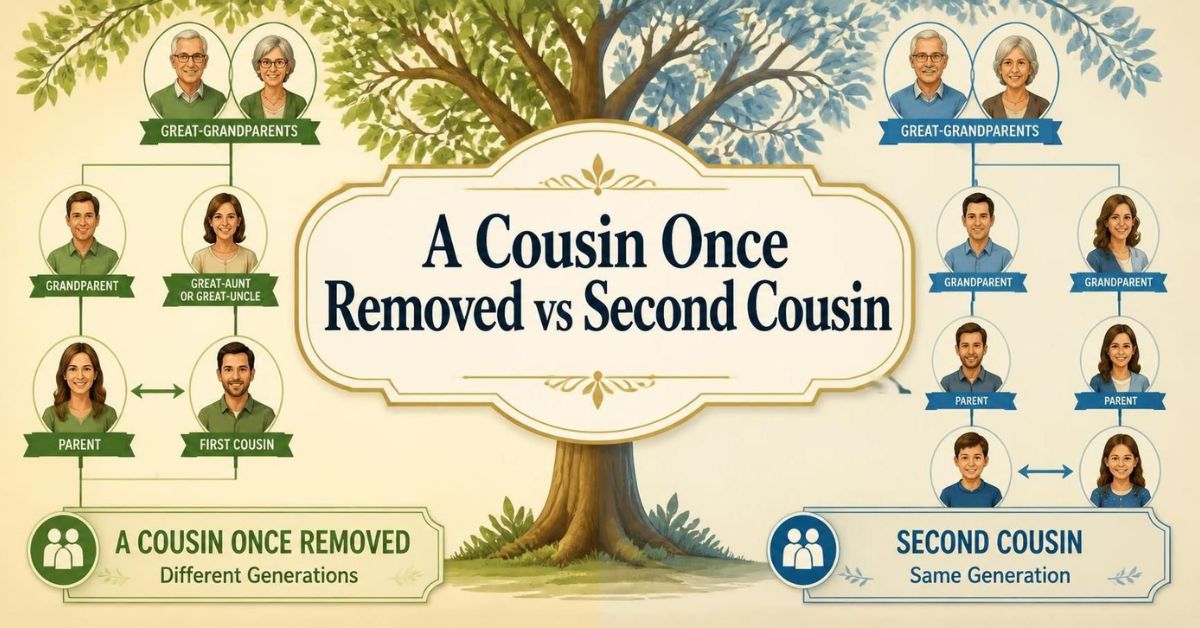
Here’s the short version. A second cousin shares your great-grandparents and sits in your own generation. A cousin once removed sits one generation above or below you. Those two ideas measure different things. One tracks cousin degree. The other tracks generational difference. Once you see that split, any family tree gets easier to read. Grab a coffee. We’ll walk through it together.
Quick Answer
A cousin once removed is a relative one generation away from you. Think of your first cousin’s child. A second cousin is a relative in your own generation who shares your great-grandparents.
So they aren’t the same thing. One describes a generational difference. The other describes cousin degree. Mixing them up is the most common slip on any family tree.
Why People Confuse Them
Both terms sound distant. Both involve a number or a twist. That makes them blur together in memory. Most of us never learned the rules in school.
Families add to the mess. Grandma calls everyone a cousin. Relatives you rarely meet get lumped together as extended family. Labels get loose fast.
Then there’s the word removed. It sounds like the person left the family. It simply marks a generation gap.
Key Differences At A Glance
Here’s a quick side by side. Keep it handy next time you sketch a family relationship chart.
| Feature | Second cousin | Cousin once removed |
| Shared ancestors | Great-grandparents | Depends on the degree (grandparents for a first cousin once removed) |
| Generation | Same generation | One generation apart |
| What it measures | Cousin degree | Generational difference |
| Example | Your parent’s first cousin’s child | Your first cousin’s child |
Notice the pattern. The degree comes from your common ancestors. The removal number comes from the generation gap.
Meaning and Usage Difference
These two labels look alike but answer different questions. Let’s take them one at a time.
What “second cousin” means
A second cousin shares great-grandparents with you. You belong to the same generation. Your parents are first cousins to each other.
Picture your great-grandmother with her grandkids and then their kids. Those great-grandchildren are second cousins. Same layer, same cousin level.
What “cousin once removed” means
A cousin once removed sits one generation up or down from you. You share a cousin line. Yet you stand on different rungs of the ladder.
Your first cousin’s child fits here. So does your parent’s first cousin. Each is a first cousin once removed.
The important distinction
Second cousin tells you how far back the shared ancestors live. Once removed tells you how many family generations separate you. They answer two different questions.
That’s why one person can carry both labels. A second cousin once removed shares great-grandparents with you but sits a generation away.
Tone, Context, and Formality
In casual chat, most people just say cousin and move on. At a barbecue nobody checks your math. Friends won’t blink.
Formal settings differ. Wedding programs, obituaries, and genealogy records call for precise kinship terminology. A wrong label there sticks around for years.
Which One Should You Use?
Match the label to your question. Talking about someone in your generation who shares your great-grandparents? Say second cousin. Talking about a generation gap? Say once removed.
Not sure about the exact line? Say distant cousin or relative. That beats guessing wrong. Then check your family tree later.
When One Choice Sounds Wrong
Calling your first cousin’s toddler your second cousin sounds off to anyone who knows genealogy. The toddler is a generation younger. That makes the label wrong.
The reverse also trips people. Calling your second cousin once removed a plain second cousin drops the generation detail. Both choices lose accuracy.
Common Mistakes (and Quick Fixes)
Most errors follow a few predictable patterns. Here are the big ones and how to fix them.
- Mistake: Calling your first cousin’s child a second cousin. Fix: Use first cousin once removed.
- Mistake: Thinking once removed means distant by blood. Fix: It only counts generations.
- Mistake: Counting from yourself instead of the ancestor. Fix: Start at the closest common ancestors.
- Mistake: Assuming your parent’s second cousin is your second cousin. Fix: That person is your second cousin once removed.
A quick habit helps. Name the shared ancestors first. Then count the steps down each side.
Everyday Examples
Real people make the rules stick. Here are five cousin relationship examples you can borrow.
Example 1: Your first cousin’s child
Your aunt has a son named Jake. Jake has a daughter named Mia.
Mia is your first cousin once removed. She’s your first cousin’s child, so she sits one generation below you.
Example 2: Your second cousin
Your mom’s first cousin Lena has a son named Omar. Omar and you share great-grandparents.
Omar is your second cousin. You sit in the same generation, so no removal applies.
Example 3: Your second cousin’s daughter
Omar later has a daughter named Zoe.
Zoe is your second cousin once removed. She’s a generation younger than you. The cousin degree stays the same.
Example 4: Your parent’s second cousin
Your dad’s second cousin is Uncle Ray, who always shows up with homemade jerky.
Ray is your second cousin once removed. He’s a generation above you, and that gap is the removal.
Example 5: Why the terms are not interchangeable
Compare Mia and Omar. Both feel like distant cousins. Yet Mia is a first cousin once removed and Omar is a second cousin.
Different ancestors, different generations, different labels. Swap them and your family tree diagram gets muddled.
| Also Read This: |
| Cosy or Cozy: Which Spelling Is Correct for US English? |
| Copys or Copies? The Correct Spelling Guide for 2026 |
| 50+ Synonyms for Gold: Brilliant Words to Know in 2026 |
Dictionary-Style Word Details
Words carry history. A quick dictionary-style look shows why these labels work the way they do.
Verb
Cousin works as a verb only in rare, old usage. It meant to call someone kin, often to win favor.
You’ll almost never see it today. Remove is the common verb here, as in removed by one generation.
Noun
Cousin is a noun for a blood relative who isn’t your sibling, parent, aunt, or uncle. Most often it names the child of your aunt or uncle.
Removed works as an adjective in kinship phrases. It signals a generation gap, as in once removed or twice removed.
Synonyms
Close cousin synonyms include kin, kinsman, relative, and relation. Each one feels looser than cousin.
None of them show the degree of relationship. If you need the exact tie, stick with the cousin label.
Example Sentences
Examples help most. Try these on for size.
- My second cousin lives two states over.
- She’s my first cousin once removed, so her mom is my first cousin.
- We found a third cousin once removed in an old census record.
Notice how each sentence names a generation or an ancestor.
Word History
Cousin comes from Old French cosin. That word traces back to Latin consobrinus, which meant a child of your mother’s sister.
The phrase once removed took hold in English kinship talk to mark steps between generations. Genealogists still lean on it today.
Phrases Containing
Several phrases borrow the word. Kissing cousin, country cousin, and cousin german all appear in everyday talk.
Cousin german means first cousin. A kissing cousin is a relative you know well enough to greet warmly.
How To Calculate Cousin Relationships
You don’t need a degree in math. Four steps do the job when you want to calculate cousin relationships:
- Find the closest shared ancestors between you and the other person.
- Count the generations from you up to those ancestors.
- Count the generations from your relative up to those same ancestors.
- Take the smaller count and subtract one. That’s the cousin degree. The gap between the two counts is the removal.
Say you’re three steps from your great-grandparents and your relative is four. The smaller count minus one gives a degree of two. That’s a second cousin. The gap is one, so it’s once removed. The same method gives you a third cousin once removed with great-great-grandparents.
Cousin Relationship Chart
A cousin relationship chart saves you from redoing the math every time. Here are the most common matches:
| Relative | Label |
| Your first cousin’s child | First cousin once removed |
| Your parent’s first cousin | First cousin once removed |
| Your parent’s first cousin’s child | Second cousin |
| Your second cousin’s child | Second cousin once removed |
| Your parent’s second cousin | Second cousin once removed |
Pin this near your family history notes. It makes understanding family tree relationships much faster.
What DNA Can Tell You
DNA tests add a twist. Second cousins share about 3% of their DNA on average, according to the ISOGG cousin statistics. A first cousin once removed averages close to 6%.
Those numbers overlap in real life. Two second cousins can share more or less than average. So pair DNA relationship discussions with genealogy records before you label anyone.
Frequently Asked Questions
What is a cousin once removed?
A cousin once removed is a relative one generation above or below you. It’s the core idea in Cousin Once Removed vs Second Cousin.
What is a second cousin?
A second cousin shares your great-grandparents and sits in your generation. Your parents are first cousins to each other.
Is a cousin once removed the same as a second cousin?
No. Cousin Once Removed vs Second Cousin compares two different measures. One tracks generation gaps. The other tracks shared great-grandparents.
Is my first cousin’s child my second cousin?
No. That child is your first cousin once removed. They sit one generation below you.
Is my second cousin’s child my second cousin once removed?
Yes. Your second cousin’s child is your second cousin once removed. The degree stays the same while the generation shifts.
Is my parent’s second cousin my second cousin once removed?
Yes. That person sits a generation above you. So they are your second cousin once removed.
Does “once removed” mean one generation apart?
Yes. Once removed means one generation apart. Twice removed means two generations apart.
Conclusion
Cousin Once Removed vs Second Cousin comes down to two simple ideas. Second cousins share great-grandparents and live in the same generation. A cousin once removed sits one generation away. Don’t let the terms blur together. Cousin Once Removed vs Second Cousin only feels tricky until you name the common ancestors.
Next time you build a family tree, start with the shared ancestors. Count the steps. The labels fall into place. Cousin Once Removed vs Second Cousin will stop being a puzzle. Got a relative you can’t place? Drop the details in the comments. Share this guide with the cousin who always asks. You might settle a family debate today.
