

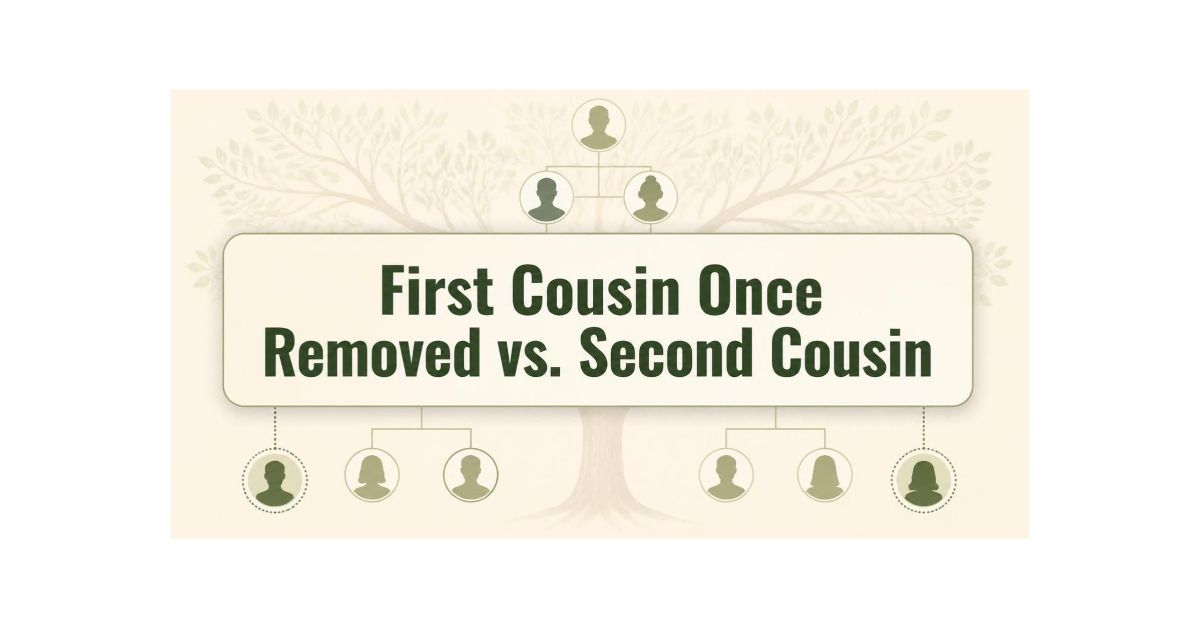
Understanding family relationships can get confusing, especially when deciding whether someone is your first cousin once removed or second cousin. Both terms describe relatives within an extended family, but they don’t mean the same thing. The main difference comes down to two things: cousin degree and generational distance. A first cousin once removed is one generation above or below you in a first-cousin relationship, while a second cousin belongs to your same genealogical generation and typically shares your great-grandparents.
These distinctions matter when building a family tree, researching ancestry, or explaining how relatives are connected. Once you understand how generations work, choosing the correct term becomes much easier, even in complicated family relationships.
Quick Answer
The difference between a first cousin once removed and a second cousin depends on your positions in the family tree.
- First cousin once removed: Someone who is one generation above or below you in a first-cousin relationship.
- Second cousin: Someone in your genealogical generation who typically shares your great-grandparents.
Here are two straightforward examples:
- Your mom’s first cousin → Your first cousin once removed.
- Your mom’s first cousin’s child → Your second cousin.
The important distinction is that once removed describes a generational difference, while second identifies the cousin degree.
Why People Confuse Them
These relationships can involve the same extended family branch, which makes it easy to mix up their names. Both terms describe relatives beyond your immediate family, and their connections often appear close together on a family tree.
Another source of confusion is the word second. People sometimes assume it simply means a relative who is one step farther away than a first cousin. However, cousin numbers and generational differences describe two separate things.
Age can also make the terminology confusing. For example, your mother’s first cousin might be only a few years older than you. Even if you are close in age, that person is still your first cousin once removed because of the generational relationship.
Remember that genealogy follows family connections rather than birthdays, personal closeness, or how often relatives see each other.
Key Differences At A Glance
The following table makes the distinction easier to understand.
| Context | Correct term | Why |
| Your parent’s first cousin | First cousin once removed | One generation above you |
| Your first cousin’s child | First cousin once removed | One generation below you |
| Your parent and another person’s parent are first cousins | Second cousin | You belong to the same next generation |
| You both share great-grandparents at the same generational level | Second cousin | This is the standard second-cousin relationship |
| There is a one-generation offset | First cousin once removed | The relationship has a generational difference |
The biggest takeaway is that a second cousin shares a particular ancestral connection with you, while a first cousin once removed describes a first-cousin relationship across different generations.
Meaning and Usage Difference
The distinction becomes clearer when you separate cousin degree from generational distance.
| Feature | First cousin once removed | Second cousin |
| Basic relationship | First-cousin relationship with a generational difference | Second-degree cousin relationship |
| Generational position | One generation apart | Same genealogical generation |
| Typical example | Your parent’s first cousin | Your parent’s first cousin’s child |
| Shared ancestry pattern | Different generational distances from the shared ancestors | Equal generational distances from shared great-grandparents |
| Term structure | First cousin + one removal | Second cousin |
A first cousin once removed can be either above or below you in the family tree.
Your parent’s first cousin is one generation above you. Your own first cousin’s child is one generation below you. Both relatives have the same relationship label.
A second cousin doesn’t have this generational difference in the standard relationship. You and that person occupy matching positions in the family tree and typically descend from the same great-grandparents.
Tone, Context, and Formality
Both expressions are standard English noun phrases used to describe family relationships. Neither is slang, and both are appropriate in formal and informal situations.
They’re particularly useful when accuracy matters, including:
- Genealogy research and family history records.
- Family tree creation and ancestry websites.
- Historical documents and family biographies.
- Conversations about extended family relationships.
- Explaining how two relatives are connected.
In everyday conversations, people often use the shorter word cousin without specifying the exact relationship. That’s perfectly natural when the distinction isn’t important.
However, if you’re documenting family history or explaining a precise connection, using first cousin once removed and second cousin correctly prevents misunderstandings.
There is also no meaningful pronunciation difference to learn. The challenge is understanding the family relationship rather than saying either expression correctly.
A Simple Method for Identifying Cousin Relationships
Which One Should You Use?
You can identify the correct relationship by asking two questions about your family tree.
First, are you and the other person in the same genealogical generation?
If both of you descend from the same great-grandparents and occupy matching generations, you’re second cousins.
Second, is one person one generation above or below the other in a first-cousin relationship?
If so, the correct term is first cousin once removed.
Consider this example:
Suppose your father has a first cousin named Daniel. Daniel is your first cousin once removed because he belongs to your father’s generation.
Daniel has a daughter named Maya. If Maya belongs to your generation, she’s your second cousin because your parents are first cousins.
This simple approach works for most standard cousin relationships.
When One Choice Sounds Wrong
Using the wrong cousin term can create confusion, especially when explaining relationships to someone unfamiliar with genealogy.
Calling your parent’s first cousin your second cousin is incorrect under standard genealogical terminology. Your parent and that relative are first cousins. Since you’re one generation below them, the relationship becomes first cousin once removed.
The reverse mistake happens when people call their parent’s first cousin’s child a first cousin once removed. In the standard family relationship, that person is your second cousin because you and that relative belong to the same generation.
The word removed shouldn’t be added simply because someone feels like a distant relative. It has a specific genealogical meaning.
How to Read Cousin Relationships on a Family Tree
A family tree can make these connections easier to follow because it shows how different relatives descend from shared ancestors.
Start by locating the closest common ancestors of both people. Then count how many generations separate each person from those ancestors.
For example:
- You and your first cousin share grandparents.
- You and your second cousin share great-grandparents.
- You and your third cousin typically share great-great-grandparents.
- You and your first cousin once removed have a one-generation difference in an otherwise first-cousin relationship.
This method is particularly helpful when researching older generations. Instead of relying on family stories or assumptions about age, you can follow the actual parent-child connections.
Common Mistakes (and Quick Fixes)
Even people who understand basic family relationships sometimes confuse cousin terminology. Here are five common mistakes and their corrections.
Mistake: Thinking “removed” means emotionally distant.
Quick fix: In genealogy, removed refers to the number of generations separating two relatives, not their emotional relationship.
Mistake: Using age to identify generations.
Quick fix: Follow the family tree. Two relatives can be close in age while occupying different genealogical generations.
Mistake: Calling a cousin’s child a second cousin.
Quick fix: Your first cousin’s child is your first cousin once removed.
Mistake: Calling your child and your cousin’s child first cousins once removed.
Quick fix: Your child and your first cousin’s child are second cousins because they belong to the same generation.
Mistake: Assuming “second cousin” means any more distant cousin.
Quick fix: Second cousin has a specific meaning. In the standard full-cousin relationship, second cousins share great-grandparents.
Another useful tip is to remember that cousin numbers describe the degree of relationship, not the number of generations separating two people. This prevents most terminology mistakes.
Everyday Examples
Real-life examples are often easier to remember than formal definitions. Here are some natural sentences showing how both expressions work.
First cousin once removed:
- “My dad’s cousin Rebecca is my first cousin once removed.”
- “My cousin Jason recently had a daughter, who is my first cousin once removed.”
- “My grandmother’s first cousin is my first cousin twice removed, not my second cousin.”
- “Emma is one generation below her mother’s first cousin, so they’re first cousins once removed.”
Second cousin:
- “Rachel and I are second cousins because our parents are first cousins.”
- “I met several second cousins at our family reunion.”
- “My mother and Ben’s father are first cousins, which makes Ben my second cousin.”
- “Olivia and I discovered that our grandmothers were sisters, so we are second cousins.”
These examples show why the two terms shouldn’t be used interchangeably. The correct label depends on how the people connect through their ancestors.
How Other Family Relationships Affect Cousin Labels
Not every family follows a simple pattern. Half relationships, blended families, adoption, and complicated family histories can make cousin terminology more difficult.
Understanding these variations can help you describe relationships more accurately.
Half First Cousins
Half first cousins are related through one shared grandparent rather than two shared grandparents.
For example, imagine two people whose parents are half-siblings. Those two people are half first cousins.
Their relationship is different from that of standard first cousins, but the generational principle still applies when identifying removed relationships.
Cousins Across Multiple Generations
A cousin relationship can have more than one generation of difference.
For example, if your grandparent’s first cousin is your relative, that person is your first cousin twice removed.
The number before removed identifies the generation gap:
- Once removed: One generation apart.
- Twice removed: Two generations apart.
- Three times removed: Three generations apart.
This pattern makes it easier to understand relationships involving grandparents, grandchildren, and more distant descendants.
Adoptive and Blended Family Relationships
Adopted relatives and blended families can also have meaningful cousin relationships.
For genealogical purposes, biological ancestry and legal or family relationships may be recorded differently. An adopted child may be treated as a cousin within their adoptive family, even without a biological connection.
The most appropriate terminology depends on whether you’re describing biological ancestry, legal family relationships, or the way relatives identify within their family.
Dictionary-Style Word Details
Understanding how these expressions function in English can help when using them in writing or researching family history.
Verb
First cousin once removed: This expression isn’t used as a verb in standard American English. It’s a noun phrase describing a family relationship.
Second cousin: This is also a noun phrase rather than a verb. It identifies someone connected through a particular ancestral relationship.
Noun
First cousin once removed: A relative who is one generation above or below you in a first-cousin relationship. Common examples include your parent’s first cousin and your first cousin’s child.
Second cousin: A relative whose parent is a first cousin of your parent. In the standard full-cousin relationship, second cousins share great-grandparents.
Synonyms
Neither expression has an exact synonym that maintains the same genealogical precision.
For first cousin once removed, useful descriptive alternatives include:
- My parent’s first cousin.
- My first cousin’s child.
- A relative one generation above or below me in a first-cousin relationship.
For second cousin, descriptive alternatives include:
- The child of my parent’s first cousin.
- A relative who shares my great-grandparents in the standard cousin relationship.
These descriptions explain the connection but aren’t always interchangeable with the formal terms.
Neither expression has a natural antonym because each describes a specific family relationship rather than an opposite quality.
| You May Also Like: |
| Make Do or Make Due: Which One Is Correct in 2026? |
| Habbit or Habit: Which Spelling Is Correct in 2026? |
| Drier or Dryer: Meaning, Difference, and Usage Guide 2026 |
Example Sentences
Here are additional examples showing how to use both expressions naturally in everyday American English.
First cousin once removed:
- “My mother’s first cousin lives in Arizona, so he’s my first cousin once removed.”
- “My first cousin recently had a son, who is my first cousin once removed.”
- “I met my father’s first cousin at a family gathering last weekend.”
- “My cousin’s daughter is technically my first cousin once removed.”
Second cousin:
- “Rachel and I are second cousins because our parents are first cousins.”
- “I met several second cousins during our annual family reunion.”
- “My grandmother and your grandmother were sisters, making us second cousins.”
- “We discovered that we share the same great-grandparents, so we’re second cousins.”
Notice that both expressions work as nouns in these sentences. They identify the relationship between people rather than describing an action.
Word History
Both expressions belong to the traditional English system of describing extended family relationships.
The term second cousin uses the word second to identify a cousin degree. It distinguishes the relationship from first cousins, who share grandparents in the standard family-tree structure.
In first cousin once removed, the phrase contains two separate pieces of information. First cousin identifies the cousin degree, while once removed describes a one-generation difference between the relatives.
This system makes it possible to describe family connections across several generations without inventing a different name for every relationship.
For modern English usage, understanding the structure is more important than memorizing a detailed historical explanation.
Phrases Containing
Both expressions appear in several common phrases, particularly in conversations about genealogy, ancestry, and extended families.
Common phrases with first cousin once removed:
- My first cousin once removed.
- Her first cousin once removed.
- Maternal first cousin once removed.
- Paternal first cousin once removed.
- First cousins once removed.
- My first cousin once removed on my father’s side.
Common phrases with second cousin:
- My second cousin.
- Her second cousin.
- Second cousin on my mother’s side.
- Second cousins.
- My maternal second cousin.
- Second cousin through my father’s family.
These variations help clarify which side of the family a relative belongs to. However, adding words such as maternal or paternal doesn’t change the underlying cousin relationship.
FAQs
What is a first cousin once removed?
A first cousin once removed is someone who is one generation above or below you in a first-cousin relationship. Your parent’s first cousin and your first cousin’s child are both examples. The term describes their genealogical positions, not their ages or emotional closeness.
What is a second cousin?
A second cousin is someone in the same genealogical generation as you whose parent is a first cousin of your parent. In the standard full-cousin relationship, you share great-grandparents.
Is my parent’s first cousin my second cousin?
No. Your parent’s first cousin is your first cousin once removed. Your parent and that relative are first cousins, making you one generation below their relationship.
Is my first cousin’s child my second cousin?
No. Your first cousin’s child is your first cousin once removed. However, your child and your first cousin’s child are second cousins because they belong to the same genealogical generation.
What does “once removed” mean in family relationships?
Once removed means two relatives have a one-generation difference in their cousin relationship. Your parent’s first cousin is one generation above you, while your first cousin’s child is one generation below you. Both are your first cousins once removed.
Do second cousins share grandparents?
No, not in the standard full-cousin relationship. Second cousins typically share great-grandparents, while their parents are first cousins. Their grandparents are usually siblings.
Can first cousins once removed be the same age?
Yes. Two relatives can have a similar age but still belong to different genealogical generations. For example, your parent’s first cousin might be close to your age, but the family-tree relationship still makes that person your first cousin once removed.
What is the easiest way to remember first cousin once removed vs second cousin?
Remember that removed measures the difference in generations, while second identifies the cousin degree. If you’re one generation apart in a first-cousin relationship, use first cousin once removed. If you belong to the same generation and share great-grandparents, use second cousin.
Conclusion
The difference between first cousin once removed vs. second cousin comes down to cousin degree and generational distance. Your parent’s first cousin and your first cousin’s child are both your first cousins once removed because each relationship involves a one-generation difference. A second cousin, however, belongs to your genealogical generation and typically shares your great-grandparents.
When you’re unsure which expression to use, look at the family tree rather than relying on age, family closeness, or assumptions. Remember one simple rule: removed measures the generation gap, while second identifies the cousin degree. Understanding this distinction makes family conversations, genealogy research, and ancestry records much easier to navigate.
