

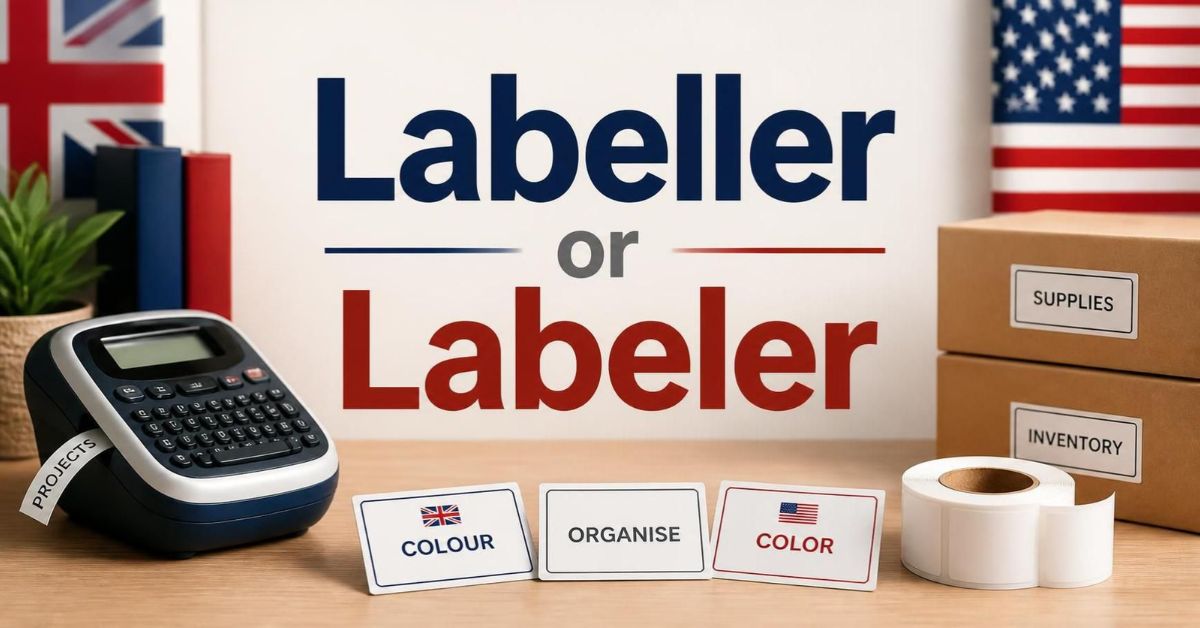
Have you ever wondered whether to write labeller or labeler in an email, report, or product description? Both spellings are correct, but your choice depends on the type of English you use.
Labeler is the standard American English spelling, while labeller is more common in British English. Both words describe a person or machine that applies labels to products, packages, or other items. The difference is spelling, not meaning. If you write for an American audience, choose labeler. If your readers follow British English, labeller is usually the better option. Understanding this small difference helps you avoid spelling errors and keep your writing consistent. It also matters when preparing business documents, packaging instructions, product descriptions, and workplace materials for readers in different countries.
Quick Answer
The labeller or labeler spelling question has a simple answer: both forms are accepted English words. American English generally uses labeler, while British English commonly prefers labeller. Neither spelling is inherently wrong, so the right choice depends on your audience and preferred spelling style.
For example, an American company might advertise an automatic labeler for its packaging line. A British manufacturer might describe similar equipment as an automatic labeller. Both descriptions communicate the same idea. Choose one spelling convention and use it consistently throughout your article, website, or business document.
Why People Confuse Them
The confusion starts with the verb label, which means to attach a label to something or describe something using a particular term. When you add the ending -er, you create a noun for someone or something that performs the action. The question is whether the final consonant should be doubled.
American English usually keeps one l in labeler. British English often doubles it to form labeller. This difference appears in other words, too. Americans generally write traveling, while British writers often use travelling. The spelling may change, but the basic meaning stays the same.
Another reason for the confusion is that people encounter both spellings online. International websites, product listings, and technical manuals often mix American and British conventions. A search for labeling equipment might show both forms, even when the products perform identical tasks.
Key Differences At A Glance
The main difference between labeler and labeller is regional spelling. Their meanings, grammatical roles, and pronunciation are generally the same. You do not need to learn two separate definitions to use them correctly.
| Feature | Labeler | Labeller |
| Preferred variety | American English | British English |
| Meaning | Person or machine that applies labels | Person or machine that applies labels |
| Part of speech | Noun | Noun |
| Pronunciation | Generally the same | Generally the same |
| Common setting | US business writing and product descriptions | UK business writing and product descriptions |
| Related verb form | Label | Label |
| Related activity | Labeling | Labelling |
Meaning and Usage Difference
The labeler meaning and labeller meaning are effectively identical. Both words refer to a person who labels items or a device designed to apply labels. The surrounding sentence tells you whether the word describes a human worker or a piece of equipment.
For example, a warehouse labeler may attach shipping labels to outgoing orders. In a factory, an automatic labeler may apply product information to bottles moving along a conveyor belt. A British company could use labeller in either situation without changing the meaning.
The word also appears in offices, pharmacies, retail stores, and manufacturing facilities. A handheld labeler can help staff mark storage boxes, while a barcode labeler may prepare labels for inventory tracking. In every case, the spelling reflects the writer’s preferred English variety, not a difference in function.
Tone, Context, and Formality
Neither spelling is more formal or professional by itself. Labeler fits American business writing, while labeller suits British-style writing. Your choice should match the audience, company standards, and language used elsewhere in the document.
Consider a job description for a warehouse employee. An American employer would normally write warehouse labeler, whereas a British employer might use warehouse labeller. Both phrases sound natural within their respective spelling conventions.
The same principle applies to resumes, workplace instructions, product descriptions, and packaging manuals. If your company already uses American spelling in words such as color, organize, and labeled, use labeler as well. If it follows British conventions such as colour, organise, and labelled, labeller will usually fit better.
Which One Should You Use?
Choose labeler if you are writing for readers in the United States. It is the usual American spelling and works well in articles, product listings, technical documentation, and job advertisements. It is also a sensible choice for an American website that uses standard American spelling throughout.
Choose labeller if your audience primarily uses British English. This spelling is common in British writing and may also appear in other English varieties that follow British conventions. However, regional preferences can vary, so check your organization’s style guide when one is available.
If you are writing for an international audience, consistency matters more than choosing one spelling as universally correct. Pick the form that suits your main readers, then use it throughout the article. Avoid switching between labeler and labeller without a clear reason.
When One Choice Sounds Wrong
Neither spelling is grammatically wrong in general English. However, one form may look out of place when it conflicts with the spelling style used in the rest of a document. An American article that uses labeler but switches to labelling may appear inconsistent to some readers.
For instance, a US product page might describe a machine as a bottle labeller while using American spelling everywhere else. The phrase remains understandable, but bottle labeler would usually match the page’s style better. The reverse applies to a British page that consistently follows British conventions.
Context can also affect whether a word choice sounds natural. If you mean a person who applies labels, either noun can work. If you mean a specific machine, a more precise term such as automatic label applicator may help readers understand the equipment being discussed.
Common Mistakes (and Quick Fixes)
One common mistake is assuming that labeller is incorrect because it contains a double l. The spelling is accepted in British English, so there is no need to remove the extra letter when writing for a British audience.
Another mistake is confusing the noun with related verb forms. The noun describes a person or device, while label is the base verb. The related forms labeling and labelling follow different regional conventions, as do labeled and labelled.
Use these quick fixes to keep your writing accurate:
- American English: labeler, labeling, labeled.
- British English: labeller, labelling, labelled.
- Business writing: follow the company’s established spelling guide.
- Product descriptions: use the spelling preferred by the target market.
- Resumes and job applications: match the spelling convention used by the employer when practical.
- International content: select one variety of English and apply it consistently.
A final proofreading check can catch mixed forms before publication. Search your document for labeler, labeller, labeling, labelling, labeled, and labelled. Confirm that each form fits your chosen spelling style.
Everyday Examples
Examples make the labeler vs labeller distinction easier to remember. The following sentences show how each spelling works naturally in context.
American English examples
- The warehouse hired a labeler to prepare outgoing packages.
- We installed an automatic labeler on the production line.
- The pharmacy uses a labeler to print patient information on medicine containers.
- She bought a handheld labeler to organize office supplies.
- The company needs a barcode labeler for its inventory system.
British English examples
- The warehouse hired a labeller to prepare outgoing parcels.
- We installed an automatic labeller on the production line.
- The pharmacy uses a labeller to mark medicine containers.
- She bought a handheld labeller to organize office supplies.
- The company needs a barcode labeller for its stockroom.
Notice that the meaning stays the same in each pair. The examples simply reflect different regional spelling preferences. Some vocabulary, such as packages and parcels, can also vary by region, but that is separate from the spelling of labeler.
| You May Also Like: |
| Weiner or Wiener: Which Spelling Is Correct in 2026? |
| Totalling or Totaling: Which Spelling Is Correct in 2026? |
| Laid Off or Layed Off: Which One Is Correct? |
Related Words: Labeling vs Labelling
The spelling difference also appears in words formed from the verb label. American English usually uses labeling and labeled, with one l after the first syllable. British English commonly uses labelling and labelled, doubling the consonant before the suffix.
For example, an American company might say, The team is labeling the boxes. A British company might write, The team is labelling the boxes. Both sentences are correct within their respective conventions.
These patterns are useful when writing about product labeling, shipping processes, or packaging instructions. Remember that the base word remains label in both varieties. The regional difference appears when certain endings are added, so check the whole word rather than relying on the spelling of the base alone.
Dictionary-Style Word Details
This section explains how the word functions in English and how it connects with related terms. Both spellings are nouns, and both can refer to a person or a machine that applies labels.
Verb
The base verb is label, meaning to attach a label to something or identify it with a word or description. For example, you might label a box with its contents or label a bottle with its ingredients.
The verb can also mean to classify someone or something. A teacher might label a response incorrect, or a reviewer might label a product unreliable. The exact meaning depends on context, but the base verb is spelled label in both American and British English.
Noun
Labeler and labeller are nouns formed from the verb label. The ending -er commonly identifies a person or thing that performs an action. Here, the word may describe a worker who applies labels or equipment that does the job.
In manufacturing, an automatic labeler applies labels to products with limited manual handling. A handheld labeler helps someone print or attach labels in an office, shop, or storage area. The term can also appear in technical descriptions of a labeling machine or other labeling equipment.
Synonyms
The best synonym depends on whether you mean a person or a machine. For a person, labeling worker or person who labels may be clearer than a single-word substitute. Tagger can work in some settings, although tagging and labeling are not always identical tasks.
For equipment, possible alternatives include label applicator, label printer, and tagging machine. These terms are not interchangeable in every context. A label printer produces labels, while a label applicator attaches them to products. If you are writing technical instructions, choose the term that accurately describes the device.
Example Sentences
Here are additional labeler example sentences and labeller example sentences that show the words in practical settings. Each sentence gives a clear meaning without changing the regional spelling pattern.
- The American supplier recommended a bottle labeler for the new packaging line.
- The British factory purchased a bottle labeller for its production team.
- Our labeler prints shipping information before each parcel leaves the warehouse.
- The labeller applies product labels to jars at a steady pace.
- The office manager replaced the old handheld labeler.
- The warehouse supervisor checked the automatic labeller before production began.
These examples also show why context matters. A labeler can be a person or a device, so surrounding words often make the intended meaning clear.
Word History
The word label entered English through French and has a longer history connected with written marks, slips, and identifying tags. The noun and verb developed uses involving the identification or description of objects, people, and categories.
The ending -er forms a noun for someone or something that performs an action. Both labeler and labeller follow that pattern. Their spelling difference reflects broader regional conventions for doubling consonants when adding certain endings, rather than a difference in origin or meaning.
Phrases Containing
You may encounter the word in several common technical and workplace phrases. The preferred spelling usually follows the regional style of the document.
- Automatic labeler or automatic labeller
- Handheld labeler or handheld labeller
- Warehouse labeler or warehouse labeller
- Bottle labeler or bottle labeller
- Barcode labeler or barcode labeller
- Shipping labeler or shipping labeller
- Price labeler or price labeller
- Pharmacy labeler or pharmacy labeller
Some phrases are more common in particular industries than others. For example, a manufacturer may use automatic label applicator in technical specifications. A retailer might use price labeler for a tool that marks merchandise. Choose terminology that matches the equipment and the audience.
How to Keep Spelling Consistent Across Your Website
If you publish articles for readers in different countries, create a simple spelling policy. Decide whether your main content follows American or British English, and record the preferred forms of frequently used words. This prevents small inconsistencies from spreading across blog posts and product pages.
For American content, use labeler, labeling, and labeled. For British content, use labeller, labelling, and labelled. Apply the same principle to related words, headings, image captions, metadata, and downloadable documents.
Consistency also helps readers recognize your intended audience. It does not guarantee higher search rankings, but it makes your content look carefully edited and easier to follow. When quoting a source or reproducing an official product name, preserve the original spelling instead of changing it to match your house style.
Frequently Asked Questions
Is it labeler or labeller?
Both labeler and labeller are correct. American English generally prefers labeler, while British English commonly uses labeller for the same meaning.
Is labeler correct in American English?
Yes, labeler is the standard American spelling. It describes a person or machine that applies labels to products, packages, or other items.
Is labeller wrong?
No, labeller is a valid spelling, especially in British English. It is not incorrect simply because it uses a double l.
What is the difference between labeler and labeller?
The difference is regional spelling, not meaning. Labeler is more common in American English, while labeller is more common in British English.
How do you spell labeler in the USA?
In the United States, spell it labeler, with one l before the ending. The related forms are labeling and labeled.
How do you spell labeller in British English?
In British English, labeller is a common spelling, with a double l. Related forms often include labelling and labelled.
What does labeler mean?
A labeler is a person or device that applies labels. It can refer to a worker, a handheld tool, or an automatic machine.
Which spelling should I use for a US audience?
Use labeler for a US audience. Keep related forms such as labeling and labeled consistent with standard American spelling.
Can labeller be used in American English?
Yes, readers can understand labeller, but it is less typical in American English. Use labeler when following standard US spelling conventions.
Is labeler a noun?
Yes, labeler is a noun. It identifies a person or device that labels items, while label can function as a verb or noun.
Conclusion
The choice between labeller or labeler comes down to regional spelling conventions. Both words have the same meaning and can describe a person or machine that applies labels. Labeler is the standard American English spelling, while labeller is common in British English.
If you are writing for a US audience, choose labeler and use labeling and labeled in related sentences. For a British audience, labeller, labelling, and labelled usually fit better. The most important step is to keep your spelling consistent across articles, business documents, product descriptions, and workplace instructions. Neither form is universally wrong, and neither automatically makes writing more professional. Choose the version that suits your readers, check your preferred style guide, and apply the same spelling throughout your content.
