

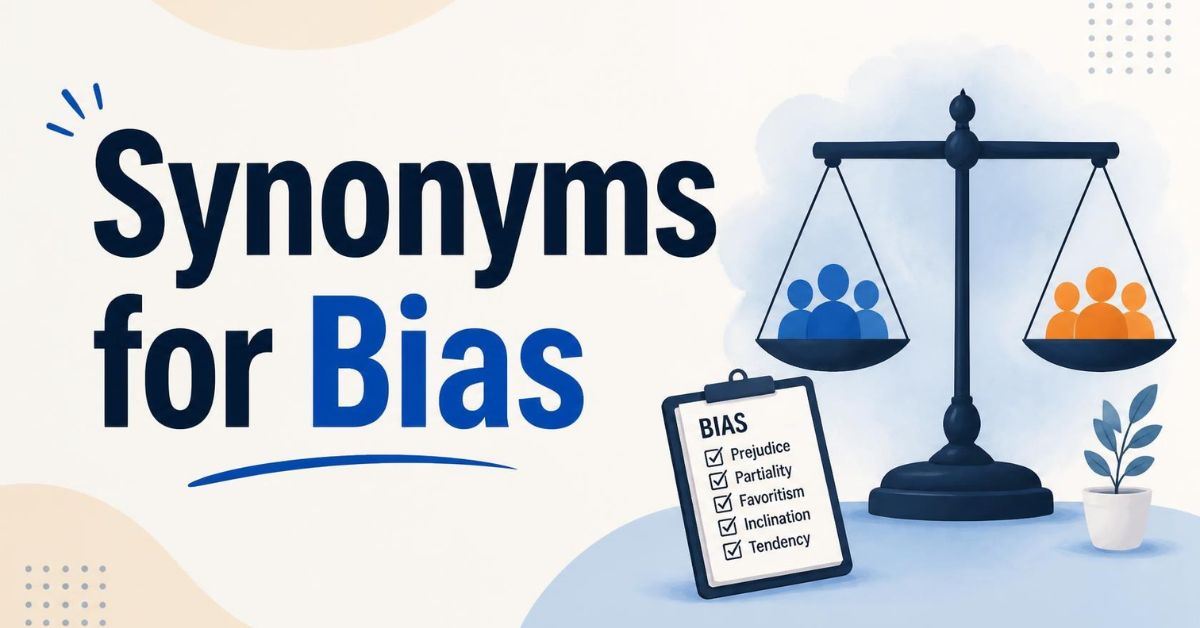
Bias shows up everywhere, in news, hiring, and everyday chats. But the word “bias” gets repetitive fast when you write or speak often.
That’s where synonyms for bias come in handy. This guide walks you through 50+ words that capture different shades of bias, from mild leanings to full-blown prejudice. You’ll learn what each word really means and when to use it. No fluff, just words that work.
Main Content – 50 Synonyms for Bias
Each word below carries its own flavor. Some fit casual talk, others suit formal writing. Pick based on tone and context.
Prejudice
Prejudice means forming an opinion before you have the facts. It often carries a negative charge and points to unfair judgment about people or groups.
Partiality
Partiality shows favor toward one side. You’ll hear it in legal or workplace settings when someone can’t judge fairly.
Favoritism
Favoritism happens when someone treats a person better for personal reasons, not merit. Think of a boss who always picks the same employee for perks.
Inclination
Inclination is a gentler word. It just means a natural pull toward one option, without heavy judgment attached.
Tendency
Tendency describes a pattern, a habit of leaning one way. It’s neutral and works well in data or behavior discussions.
Predisposition
Predisposition suggests a built-in leaning, sometimes from upbringing or biology. Doctors use this word often when discussing health risks.
Leaning
Leaning is casual and common in political talk. Someone with a “leaning” isn’t fully committed, just tilted toward a side.
Distortion
Distortion means the truth gets bent or twisted. Use this when facts get skewed on purpose or by accident.
Unfairness
Unfairness is straightforward. It points directly to unequal treatment without dressing it up.
One-sidedness
One-sidedness describes content or opinions that ignore other perspectives entirely. News reports get criticized for this often.
Subjectivity
Subjectivity means personal feelings shape the judgment, rather than objective facts. It’s common in reviews and opinion pieces.
Discrimination
Discrimination goes a step further than bias. It’s bias acted upon, often unfairly targeting people based on traits like race or gender.
Skewness
Skewness is a technical term, mostly used in statistics, to describe data that leans unevenly in one direction.
Preconception
Preconception is a belief formed before real experience. You judge something before you actually encounter it.
Prejudgment
Prejudgment is close to preconception. It means deciding on an outcome or person before all evidence is in.
Tilt
Tilt is short and punchy. It works well in casual writing when something leans slightly one way.
Slant
Slant often describes media coverage. A story with a slant pushes one viewpoint over another.
Outlook
Outlook is broader. It’s how someone views the world, shaped by their experiences and values.
Mindset
Mindset refers to a fixed way of thinking. It can lead to biased choices without the person even noticing.
Partisanship
Partisanship ties directly to political sides. It means strong loyalty to one party or group, often at the cost of fairness.
Preferentiality
Preferentiality means giving special treatment to a chosen option or person, similar to favoritism but used in formal contexts.
Inequity
Inequity points to a lack of fairness in systems or outcomes, often used in social justice conversations.
Imbalance
Imbalance suggests things are out of proportion, one side getting more weight than it should.
Dogmatism
Dogmatism means sticking rigidly to a belief, refusing to consider other views even with new evidence.
Stereotype
Stereotype is a fixed, oversimplified idea about a group of people. It ignores individual differences entirely.
Assumption
Assumption means taking something as true without proof. It’s a quiet form of bias that sneaks into daily decisions.
Expectation bias
Expectation bias happens when you see what you expect to see, shaping results based on what you already believed.
Confirmation bias
Confirmation bias is one of the most talked-about terms today. It means seeking out information that backs your existing views while ignoring the rest.
Selective perception
Selective perception means noticing only the details that match your beliefs and filtering out the rest.
Prejudging
Prejudging is the act of judging before knowing the full picture, similar to prejudgment but used as an active verb.
Skewed thinking
Skewed thinking describes reasoning that’s been bent by personal feelings, leading to distorted conclusions.
Clouded judgment
Clouded judgment means emotions or bias block clear thinking, making decisions less rational.
Twisted perspective
Twisted perspective is a strong phrase for a viewpoint that’s been warped by bias or misinformation.
Narrow-mindedness
Narrow-mindedness means refusing to consider other opinions or lifestyles, sticking only to what feels familiar.
Closed-mindedness
Closed-mindedness is similar, but it emphasizes total unwillingness to hear new ideas at all.
Pre-set opinion
A pre-set opinion is one you already hold before even looking into a topic, closing the door on new information.
Fixed belief
A fixed belief doesn’t budge, no matter what evidence shows up. It’s a rigid, unchanging stance.
Rigid thinking
Rigid thinking means sticking to old patterns and rejecting flexibility, even when it would help.
Selectivity
Selectivity means choosing only certain facts or details that support a specific angle.
Preference
Preference is the mildest term here. It just means liking one option more, without deep judgment behind it.
Viewpoint bias
Viewpoint bias happens when your personal stance colors how you interpret events or people.
Angle (bias angle)
An angle refers to the specific slant a writer or speaker takes, often shaped by their own bias.
Frame of mind
Your frame of mind is your current mental state, which can quietly shape how fair or unfair your judgments turn out.
Interpretive bias
Interpretive bias means the same facts get read differently depending on the person’s existing beliefs.
Perceptual bias
Perceptual bias affects how your senses and brain process information, often without you realizing it.
Cognitive bias
Cognitive bias is a broad psychology term covering many mental shortcuts that lead to flawed judgment.
Social bias
Social bias comes from cultural norms and group influence, shaping how people judge others in society.
Media bias
Media bias refers to slanted reporting, where news outlets favor one narrative over balanced coverage.
Analytical bias
Analytical bias shows up in research or data work, when analysts unconsciously favor results that match their hypothesis.
Prejudicial stance
A prejudicial stance is a firm, biased position taken on an issue, often resistant to change.
How to Pick the Right Synonym for Bias
Context matters more than the word itself. A casual conversation calls for simple terms like “leaning” or “preference.” Formal writing, like reports or legal documents, works better with words such as partiality or prejudicial stance.
Think about intensity too. Assumption and inclination feel light, while discrimination and dogmatism carry heavier weight. Match the word to how strong the bias actually is.
Don’t forget your audience. Academic readers expect terms like cognitive bias or confirmation bias, while everyday readers connect better with plain phrases like unfair thinking or one-sided thinking.
Common Mistakes When Using Bias Synonyms
Many writers swap words without checking their true meaning. Using “discrimination” when you mean “preference” changes the whole tone of a sentence.
Another mistake is overusing heavy words like prejudice in light situations. Save strong terms for real unfairness, not minor personal taste. Keep your language matched to the actual weight of the situation.
Frequently Asked Questions
What is the most common synonym for bias?
Prejudice and partiality are the most common synonyms for bias in everyday use.
Is “tendency” the same as bias?
Not exactly. Tendency is softer and doesn’t always imply unfairness or judgment.
Can “preference” be a form of bias?
Yes, mild preference can turn into bias if it affects fair treatment of others.
What word fits formal writing best?
Partiality or prejudicial stance work well in formal or legal writing.
Is confirmation bias different from regular bias?
Yes, confirmation bias specifically means favoring information that supports existing beliefs.
Which synonym works for media bias?
Slant and media bias both describe one-sided news coverage well.
Conclusion
Bias hides in daily language more than most people notice. With this list of synonyms for bias, you can pick words that match the exact shade of meaning you need.
Whether you’re writing a report, a blog, or just chatting, these alternatives keep your language fresh and precise. Use them wisely, and your writing about bias will always hit the right tone.
