

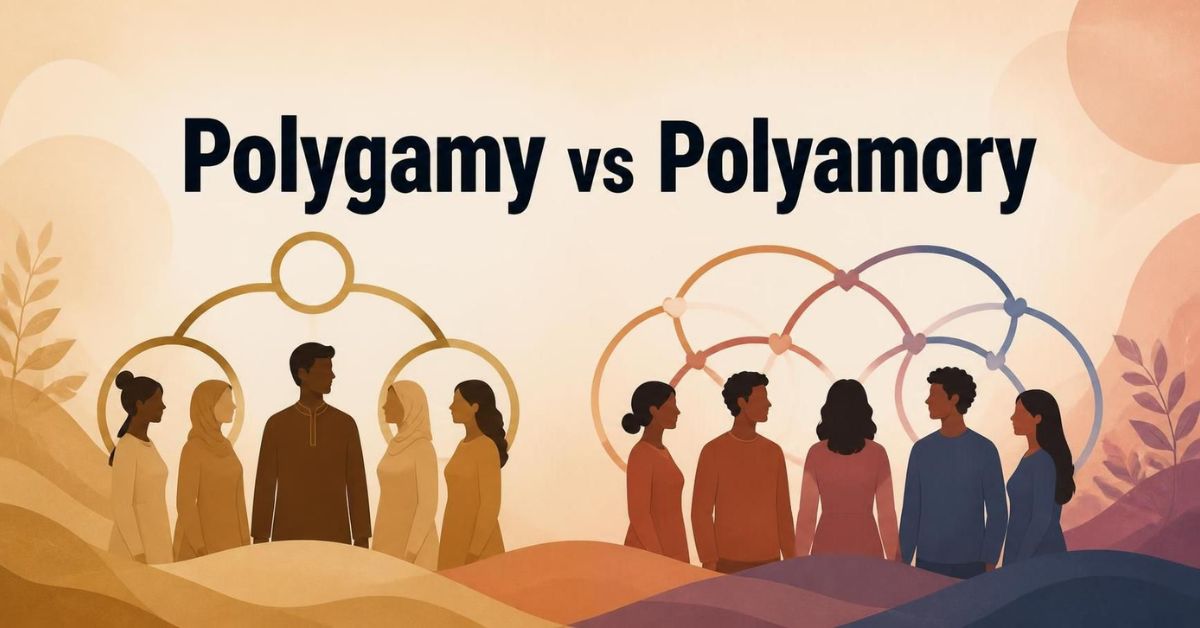
Is polygamy the same as polyamory? No, and the mix up trips plenty of people. You might’ve heard both words in a documentary or a heated group chat. Here’s the short answer. Polygamy is marriage to more than one spouse. Polyamory is having several romantic relationships with everyone’s full knowledge and consent. One is a marriage system. The other is a relationship style. Sounds simple, right? The details get interesting fast.
This guide breaks down Polygamy vs Polyamory in plain talk. You’ll see how each one works, where the law stands, and what the daily reality looks like. We’ll also cover history, religion, and how both differ from cheating. No jargon and no lectures. Just clear examples you can use.
What Is Polygamy?
Polygamy means being married to more than one spouse at the same time. The word comes from Greek and means many marriages. So the polygamy vs polyamory meaning gap starts with one word: marriage.
A polygamous person commits to multiple marriages inside one household or community. Picture a man with three wives who all hold recognized marital status within their faith or culture. Everyone knows the setup.
Most polygamous relationships follow strict marriage requirements. Religion, tradition or local law usually set the rules. The people involved don’t just decide on a Friday night.
What Is Polyamory?
Polyamory means having more than one romantic partner with everyone’s open knowledge. The word blends Greek and Latin and translates roughly to many loves. Marriage isn’t required.
A polyamorous person might date two people at once. Maybe they live with one partner and see another on weekends. Everyone involved knows the arrangement and agrees to it.
This style falls under consensual nonmonogamy. It also sits close to open relationships and other non-monogamous relationships. The core idea stays the same. Honesty comes first.
Polygamy vs Polyamory: The Core Difference at a Glance
Here’s the cleanest way to see the polygamy and polyamory difference. Polygamy is a marriage system. Polyamory is one of many relationship structures built on love and mutual consent.
| Feature | Polygamy | Polyamory |
| Main focus | Marriage | Relationships |
| Legal status | Illegal in most Western countries | Legal to practice, but not recognized as marriage |
| Usual driver | Religion or culture | Personal choice |
| Typical setup | Often one man with several wives | Any gender mix |
| Role of consent | Varies by community | Central |
Two Quick Stories That Make It Click
Picture Daniel. He lives in a close community where his faith allows men to marry more than one woman. He has two wives and one shared household. That’s polygamy.
Now meet Priya. She’s engaged to Sam and also dating Lena. Sam knows about Lena and Lena knows about Sam. That’s polyamory.
Daniel’s setup is about marriage and tradition. Priya’s is about choice and open talk. Same headline topic. Totally different worlds.
Types of Polygamy: Polygyny vs Polyandry
Polygamy splits into two forms. Polygyny means one man with several wives. Polyandry means one woman with several husbands. So when people debate polygamy vs polygyny, they’re comparing a whole category to one type inside it.
Polygyny is by far the more common form. You’ll find it in parts of Africa, the Middle East and a few fundamentalist religious groups. Polyandry is rare. It has appeared in some Himalayan regions such as parts of Tibet and Nepal.
The polygyny vs polyandry question often comes down to land and family wealth. In some Himalayan families, brothers have shared one wife so the farm stays intact. It’s a practical choice more than a romantic one.
Marriage vs Relationships: Why the Legal Line Matters
Here’s where marriage vs relationships gets real. Polygamy involves legal marriage or a recognized marriage inside a faith community. Polyamory involves emotional and romantic bonds without any marriage license.
In the United States, you can only hold one legal marriage at a time. Marrying a second person while still married is bigamy. Every state treats it as a crime.
A polyamorous person can still marry one partner. The other intimate relationships don’t get legal recognition. That’s why many people in these setups lean on contracts and wills.
Consent and Communication: How Each One Works
Polyamory runs on knowledge and consent. Every romantic partner knows about the others. Nobody hides anything.
Partners set relationship boundaries and talk about them often. For example, a group might share calendars, agree on safer sex rules and check in every Sunday. That’s open communication in action.
Polygamy handles consent differently. Some legal systems require the first wife’s approval for a new marriage. In other communities, family or religious leaders decide. Critics raise valid concerns about mutual consent here, especially for women and girls.
| You May Also Like: |
| Treck or Trek: Correct Word, Meaning, and Easy Examples |
| What Is A Cousin Once Removed vs Second Cousin: Key Differences |
| Cosy or Cozy: Which Spelling Is Correct for US English? |
Polyamory vs Open Relationships
People often lump polyamory and open relationships together. They overlap but aren’t identical. Open relationships usually focus on sexual relationships outside a main couple.
Polyamory leans toward emotional depth. You might love two people at once and build real intimate relationships with both. Think of a close friendship that also happens to be romantic.
Both count as consensual relationships. Both rely on honesty. The difference lies in how much love and commitment each partner expects.
Cheating vs Polyamory
Cheating vs polyamory is a common worry. The line is simple. Cheating breaks an agreement. Polyamory is built on agreement.
Say Maya secretly dates someone while her partner believes they’re exclusive. That’s cheating. If Maya tells her partner upfront and they agree to date other people, that’s polyamory.
The same logic applies to polygamy. A man whose wives all know and accept the setup isn’t hiding anything. A man who secretly marries a second wife is likely committing bigamy and betraying his first wife.
Monogamy vs Polygamy
Monogamy vs polygamy is the oldest comparison in the book. Monogamy means one spouse or one partner at a time. Marriage and monogamy go hand in hand in most modern laws.
Polygamy breaks that pattern. It allows multiple spouses inside one marriage structure. Polyamory breaks it differently by allowing multiple partners without changing the legal marriage model.
Neither choice is automatically better. What matters is that every adult involved chooses freely. Relationship preferences vary wildly from person to person.
A Quick Look at History and Anthropology
Anthropology shows that plural marriage appeared in many historical societies. Biblical patriarchs, many African kingdoms and several Native American nations practiced it.
Even so, polygamy usually stayed limited to wealthy or powerful men. Most men in those societies had one wife. Resources, not romance, shaped the system.
Polyamory as a named idea is much newer. The word gained traction in the 1990s through online communities and writers. Today it’s a regular topic in therapy offices and podcasts.
Religious Practices and Cultural Traditions
Many religious practices have shaped views on plural marriage. Islamic law allows a man up to four wives under strict fairness conditions. Plenty of Muslim majority countries limit it further. Most Muslims never practice polygamy.
In the United States, early members of The Church of Jesus Christ of Latter-day Saints practiced plural marriage. The church formally ended the practice in 1890. A few fundamentalist offshoot groups still practice polygamy today.
Cultural traditions also matter. Some communities in West Africa treat polygamous households as normal family life. Meanwhile, polyamory rarely connects to any religion. It’s mostly a personal and social choice.
Marriage Laws Around the World
Marriage laws differ sharply. Roughly 50 countries, mostly in Africa and Asia, allow some form of polygamy. Most Western countries ban it.
In the U.S., polygamy carries criminal penalties in most states. Utah softened its approach in 2020. It now treats polygamy among consenting adults as an infraction instead of a felony.
Polyamorous relationships generally aren’t illegal in the U.S. However, the law won’t recognize more than two partners as married. A few Massachusetts cities, including Somerville, now let multiple people register a domestic partnership.
Family Structures and Relationship Dynamics
Family structures look different in each setup. A polygamous household often centers on one shared home with one husband and several wives. Children grow up with half siblings under one roof.
Polyamorous families come in many shapes. Some partners live together. Others keep separate homes and share parenting duties. Relationship dynamics can shift, so regular check ins matter.
Jealousy shows up in both. Many people in polyamorous relationships describe it as a signal to talk, not a reason to panic. Time management is the other big challenge.
Common Myths About Polygamy and Polyamory
Myth one says all polygamous marriages look the same. They don’t. A consensual marriage between adults looks very different from coerced or underage marriage, which is illegal and harmful.
Myth two says polyamory is only about sex. Many polyamorous people say emotional connection drives their choices. Sexual relationships are just one piece.
Myth three says it’s a trend that appeared overnight. Both relationship structures have deep roots. Only the language around them has changed.
Frequently Asked Questions
Is polygamy the same as polyamory?
No. In the Polygamy vs Polyamory debate, polygamy means marriage to multiple spouses. Polyamory means multiple consensual romantic relationships without any marriage requirement.
Is polyamory legal in the United States?
Yes. In Polygamy vs Polyamory, only polygamy and bigamy face legal penalties. Polyamorous partners just can’t legally marry more than one person.
Can a polyamorous person also be married?
Yes. Polygamy vs Polyamory aside, a polyamorous person can hold one legal marriage while keeping other consensual romantic partners.
Is polygyny the same as polygamy?
Not exactly. In Polygamy vs Polyamory talks, polygyny is one type of polygamy where one man has several wives.
Is polyamory just cheating with permission?
No. In Polygamy vs Polyamory comparisons, polyamory stands out because every partner knows and agrees. Cheating relies on secrecy.
Conclusion
Polygamy vs Polyamory comes down to structure and choice. Polygamy is a marriage system that allows multiple spouses. Polyamory is a relationship style built on consent. Understanding Polygamy vs Polyamory helps you talk about both without judgment. It also keeps you from mixing up bigamy, cheating and open relationships. Law matters here too. Polygamy faces bans in most Western countries. Polyamory faces no ban but gets no legal recognition either.
So what’s the takeaway on Polygamy vs Polyamory? Ask two questions. Is there a marriage involved? Does everyone know and agree? Those answers sort almost every case. Both topics deserve honest and respectful conversation. Labels matter less than consent. Got a story or question about Polygamy vs Polyamory? Drop it in the comments. Share this guide with a friend who still mixes the two up.
